
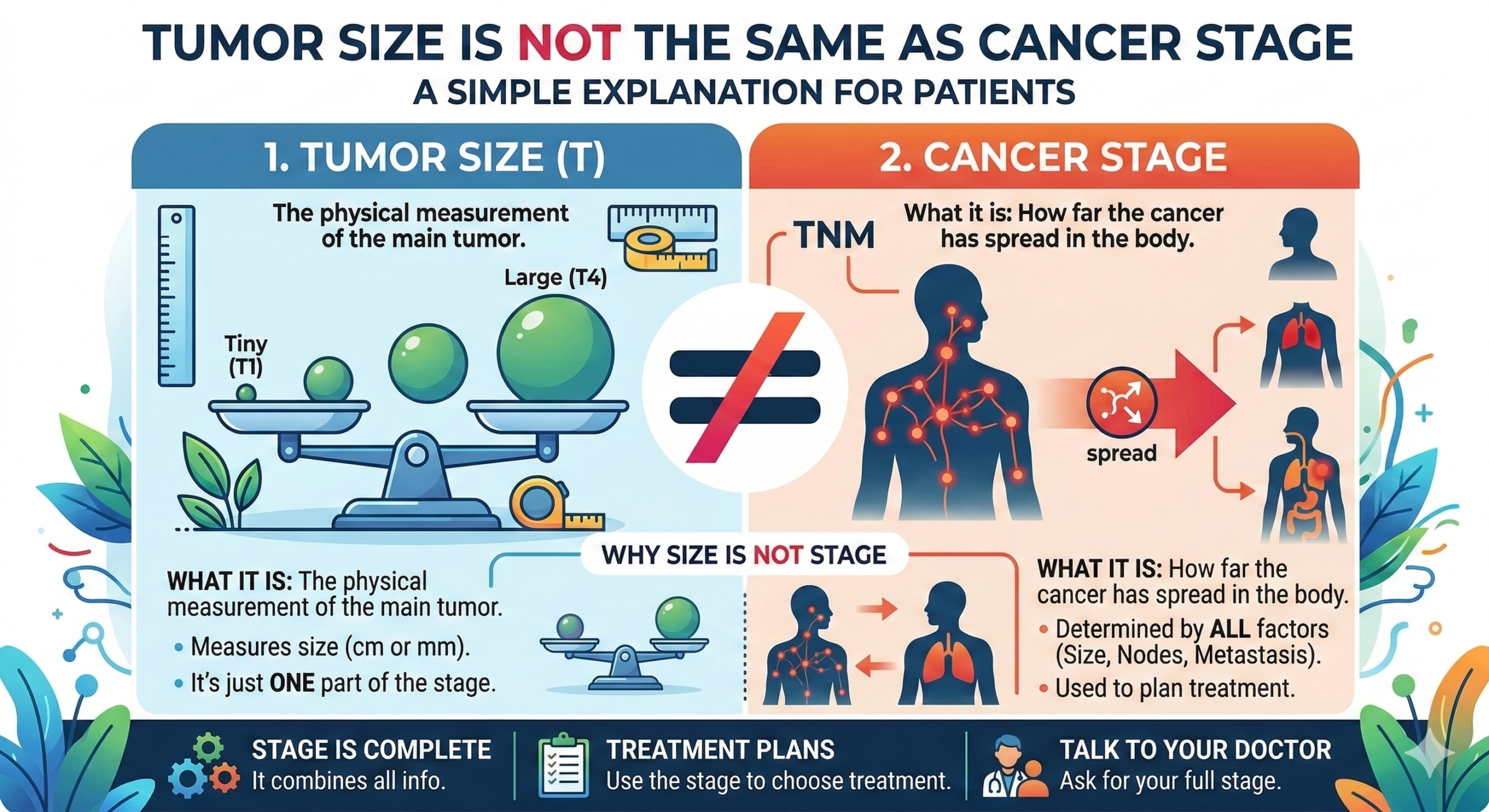
When patients read their biopsy or scan reports and see “5 cm tumor” or “10 cm mass,” panic is often the first reaction. It sounds big. It sounds frightening.
But here’s the truth: Tumor size alone does NOT define cancer stage.
As explained by Dr. Asit Arora, understanding cancer requires looking beyond just the size of the tumor. The real picture lies in whether the disease has spread to lymph nodes or other organs.
Let’s break this down clearly.
Understanding the Difference Between Tumor Size and Cancer Stage
1️⃣ What Is Tumor Size?
Tumor size simply refers to how large the growth is, usually measured in centimeters (cm).
For example:
- 2 cm tumor
- 5 cm tumor
- 10 cm tumor
Size gives doctors important information — but it’s only one part of the staging system.
A larger tumor does not automatically mean advanced cancer.
2️⃣ What Is Cancer Stage?
Cancer staging tells us how far the disease has spread in the body.
Most cancers are staged using the TNM system:
- T (Tumor) – Size and local invasion
- N (Nodes) – Whether cancer has spread to nearby lymph nodes
- M (Metastasis) – Whether cancer has spread to distant organs
For example:
- A 6 cm tumor confined to one organ with no spread may still be at an early stage.
- A 2 cm tumor that has spread to the liver or lungs may be at an advanced stage.
👉 This is why tumor size ≠ cancer stage.
Why Patients Often Get Confused
Many people assume:
“Bigger tumor = worse cancer.”
But oncology is more complex.
According to Dr. Asit Arora, prognosis depends more on:
- Lymph node involvement
- Distant metastasis
- Tumor biology
- Molecular markers
- Patient’s overall health
Not just size.
Real-Life Example
Let’s simplify it:
| Scenario | Tumor Size | Spread | Stage | Prognosis |
| Patient A | 8 cm | No lymph nodes, no metastasis | Early/Localized | Potentially curable |
| Patient B | 2 cm | Spread to liver | Stage IV | Advanced |
Clearly, spread matters more than size.
Why Lymph Nodes Matter So Much
Lymph nodes act like checkpoints in the body.
If cancer cells enter lymph nodes, it increases the risk of further spread. That’s why surgeons carefully evaluate and often remove lymph nodes during cancer surgery.
The presence or absence of nodal spread significantly changes:
- Treatment plan
- Need for chemotherapy
- Survival outcomes
The Role of Imaging and Biopsy
Doctors use:
- CT scans
- MRI
- PET scans
- Biopsy reports
to determine the true cancer stage — not just tumor measurements.
So if your report says “5 cm mass,” the next question should be:
👉 Has it spread?
Emotional Impact: Why Numbers Create Fear
Seeing a large number on a report can be overwhelming.
But remember:
- Some slow-growing cancers can become large before spreading.
- Some aggressive cancers spread early even when small.
Cancer behavior depends on biology — not just size.
Questions You Should Ask Your Doctor
If you or a loved one is diagnosed, ask:
- What is the exact stage of my cancer?
- Has it spread to lymph nodes?
- Is there metastasis to other organs?
- Is this cancer curable?
- What is the treatment plan?
Clarity reduces fear.
The Bottom Line
Tumor size is important — but it is not the full story.
Cancer stage depends on:
✔ Tumor size
✔ Lymph node involvement
✔ Distant spread
Don’t let numbers cloud your understanding. Always discuss the stage and spread with your oncologist to truly understand your prognosis.
As emphasized by Dr. Asit Arora, informed patients make stronger decisions.