

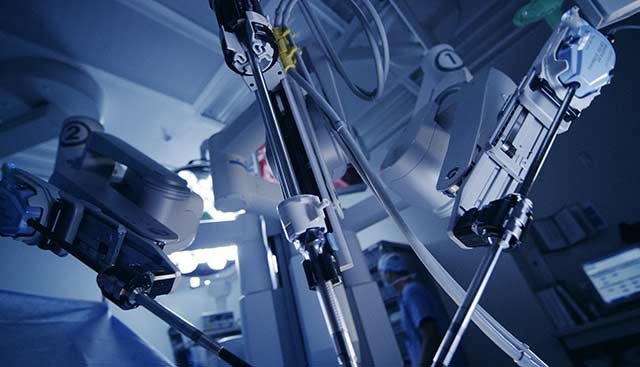
Robotic Abdominoperineal Resection (APR) is an advanced minimally invasive surgical procedure used primarily for selected cancers involving the very lower rectum and anal canal. The procedure involves removal of the rectum, anus, and anal sphincter complex, followed by creation of a permanent colostomy. Robotic APR may be recommended when a tumor is located so close to or involves the anal sphincter that preserving normal bowel function through a sphincter-sparing procedure would not provide adequate or safe removal of the disease.
The procedure combines advanced robotic technology with established colorectal cancer surgery principles. It is performed through several small abdominal incisions using a robotic surgical system equipped with a high-definition, three-dimensional camera and specialized articulated instruments. The enhanced visualization and precise instrument control can be particularly useful when operating deep within the narrow pelvic cavity, where important nerves, blood vessels, urinary structures, reproductive organs, and pelvic floor muscles are located.
How Robotic Abdominoperineal Resection Is Performed
Robotic APR is performed under general anesthesia and generally involves both an abdominal and a perineal component. During the abdominal phase, several small incisions are made to allow placement of the robotic camera and surgical instruments. The surgeon operates the robotic system from a console, controlling the instruments throughout the procedure.
The sigmoid colon and rectum are carefully mobilized, and the blood vessels supplying the affected bowel are managed according to the planned oncological resection. The surgeon performs meticulous dissection of the rectum within the pelvis, following appropriate anatomical planes while attempting to protect important nerves and surrounding structures.
For rectal cancer, the principles of Total Mesorectal Excision (TME) are generally incorporated when appropriate. This involves removal of the rectum together with the surrounding mesorectal tissue containing lymphatic structures. Careful dissection helps achieve appropriate surgical margins while minimizing unnecessary injury to adjacent pelvic structures.
The perineal component involves an incision around the anus. The anal canal, anus, sphincter muscles, and lower rectum are carefully removed along with the abdominally mobilized rectal segment. The rectum and anus are removed as an appropriate surgical specimen, with the aim of achieving complete removal of the tumor and adequate margins.
Why Robotic APR May Be Recommended
Robotic APR is generally considered for patients with very low rectal or anal canal tumors where preservation of the anal sphincter is not considered safe or appropriate. This may occur when the tumor directly involves the sphincter complex, extends into the pelvic floor, or is positioned too close to the anal muscles to allow adequate cancer clearance through a sphincter-preserving operation.
The decision to perform APR is based on detailed imaging, tumor location, disease stage, response to preoperative treatment, relationship with the sphincter complex, and the ability to achieve appropriate surgical margins.
The objective is not simply to remove the visible tumor but to perform an oncologically appropriate resection of the affected rectum and surrounding tissues while minimizing the risk of residual disease.
Robotic Technology in Pelvic Surgery
The pelvis provides limited space for surgical instruments, particularly in patients with a narrow pelvic anatomy. Robotic technology provides a magnified three-dimensional view of the surgical field and allows the surgeon to control articulated instruments capable of precise movements.
These features may facilitate delicate dissection around the rectum, pelvic nerves, blood vessels, and other important structures. Robotic instruments can also provide improved flexibility during tissue handling and suturing compared with conventional straight laparoscopic instruments.
The robotic system does not perform the operation independently. The surgeon remains in complete control of the procedure and uses the robotic platform as a sophisticated surgical tool.
Robotic APR for Rectal Cancer
For patients with rectal cancer, treatment generally begins with detailed staging and multidisciplinary evaluation. Investigations may include colonoscopy with biopsy, pelvic MRI, CT scans, blood tests, and other imaging studies as required.
Patients with locally advanced rectal cancer may receive treatment before surgery. Depending on the stage and individual circumstances, this can include chemotherapy, radiation therapy, or a combination of treatments as part of a neoadjuvant or total neoadjuvant treatment approach.
Preoperative treatment may help reduce tumor size, treat microscopic disease, and improve the effectiveness of definitive surgery. The response to treatment is assessed through clinical evaluation and imaging before the final surgical plan is confirmed.